Foraging for garlic mustard and a recipe

Sunday, May 22, 2011

Lamb's Quarters
I've been away, I apologize.


I've been baking (more later), and Monster Gramma has been canning.  We're cooking our own dinners mostly and things are pretty mellow here at Casa de Batata.  Spring has finally shown up and our gardens are in.  This has proven more difficult than last year as the Winter That Wouldn't End kept me from preparing the ground and getting plants in said ground. 

Another part of the failure to get growing was a failure of our attempt to start plants from seeds.  I'm not sure what we did wrong, but evidence points to the wrong starter medium.  The plants got a great start, but became really leggy.  More investigation is needed.

In the mean time, the opportunity presented itself for a bit of self-guided foraging.  Upon reading The Omnivore's Dilemma by Michael Pollan, wild foods came to my attention.  He specifically mentions Lamb's Quarters and Purslane as nutrient-rich and easily obtainable.  When I decided to work some of my considerable Google-Fu on the plants mentioned, I was astonished that not only did I recognize them as a gardener, but I had been throwing them out without even so much as a second thought!

Purslane 
Both plants are easily recognizable and you'd probably remember them from your last weeding session.  Both show up later in the season, but show up they will.  In my garden I have a sort of "dead spot" where all manner of greenery shows up and I'll make damn sure that I don't discard these extremely nutritious plants in the future.

Since I've been awakened to the usefulness of "weeds," we've purchased a couple of plant identification books and one on foraging for wild greens called Edible Wild Greens by John Kallas.  This brought a new collection of plants to my attention, especially dandelions, garlic mustard and field mustard.

I have a dog and we will go to a "dog park" by the Minneapolis airport a couple of times a week.  Sheila is 13 and not really interested in running much now a days, so I get a chance to examine the flora as she wanders from squat to squat.  In my travels around the park, I've noticed all manner of edible plants: dandelions, wild onions, garlic mustard, shepherd's purse, and raspberries to list the ones my novice eye can recognize.
Garlic mustard

Today, I wandered into my favorite patch of garlic mustard.  I found it over a month ago and I've been harvesting young greens from it since (it makes a wonderful green to go with scrambled eggs).  Now that the temperatures have finally reached into the 70's, it has begun to bolt (grow a flower stem) and flower and it has quadruped in size since I've first spotted and harvested it. 

Garlic mustard is interesting in that it is first and foremost considered a noxious weed; it emits a toxin from its roots to stop other plants from growing near it.  Its copious seed production can create patches that overtake native species and drive out local flora and the fauna that feeds on it, so eating it will help stop its spread, give you a tasty and easily obtained vegetable, and provide you with a tremendous burst of fibre, vitamins, minerals, and antioxidants.  You can find it quite easily and if you crush one of its heart-shaped leaves (as it probably is now at this time of the year), you'll smell the garlicy odor that give this plant its name. 

It has a slightly bitter, peppery, and garlicy taste that I find pleasant, but others may find a bit strong.  Boiling or sauteeing this plant will reduce any of the strong flavors.  I like adding the leaves to regular salad greens to add a little punch.  You can also try making what I had for dinner tonight: garlic mustard pesto.  This is different from your typical pesto in that it doesn't have any real garlic and that it has an almost "fresh-cut grass" nose and taste.  This is particularly tasty with a hearty whole-wheat pasta.  It also freezes well, so if you find a healthy patch, dig 'em up and make a big batch.

Garlic mustard pesto

2-3 cups garlic mustard leaves and tender stems (like asparagus, you can eat the flowers, buds, leaves, and stems where the stem snaps when bent)
2/3 cup grated Parmesan, Romano or other hard cheese
2/3 cup (or more) Extra Virgin Olive oil
1 cup nuts (I used pecans as that's all I had, but I think that pine nuts or walnuts would work as well)
1/2 tablespoon salt

Put the garlic mustard tops and leaves in a blender or food processor along with the cheese and pulse until the garlic mustard has been chopped fine.  Add the nuts and process until the nuts have been chopped fine and then begin processing the mix by continuously running the machine and gently adding oil until the desired consistency.  If you wish to back off on the oil, plan on adding more garlic mustard leaves and/or stems and flowers to add liquid.

This ismy Must Have at Thanksgiving dinner

Saturday, November 27, 2010

Cranberry sauce with Pinot Noir
(Bon Appetit Nov 1997- Caprial's Bistro)

1 Tbsp veg oil
2 cups cranberries (about 8 oz)
1 Tbsp minced ginger
2 cups pinot noir or other dry red wine
(we use pinot noir or zinfindel)
1 1/2 cups sugar
3 Tbsp chopped crystallized ginger
1 tsp curry powder
Large pinch of Chinese five-spice powder

Heat oil in saucepan over med-high heat. Add cranberries and fresh ginger, stir until cranberries begin to burst, about 3 min. Add wine and sugar, boil until mixture is reduced to 2 1/2 cups, about 15 min. (Note, we have found you definitely need to cook it way down. The flavor gets wonderfully intense if you do. One way to tell if you have cooked it long enough, the mixture takes on the color of the wine and thickens slightly) Add the crystallized ginger, curry and 5-spice powder. This recipe is very forgiving. Any ingredient, more or less doesn't hurt.

Give this a try. You won't believe how incredible this is. I also use this as a jam; it's also good with peanut butter.

Bread failure

Sunday, November 21, 2010

I've attempted to make a Wild Rice and Onion loaf recipe from here.  There isn't anything wrong about the recipe, but the environment is all wrong here at Casa de Batata.  We have an old house here in South Minneapolis and it is a bit, um, drafty, to say the least.  Since the place is insulated with newspapers from when the house was constructed, it does leave a bit to be desired in the protection-from-the-winter department.

Raising a dough in cool conditions isn't a problem here in November, but the second fermentation requires more time (which I didn't have) or a higher temperature (which I didn't think of).  Having a cold house is part of the cheap way we live but why I didn't have time is part of the reason we live extravagantly.

We are rarely home, so keeping a warm house makes little sense.  The animals have fur and live quite well without temps in the 60's.  The humans are rarely home and the need for warmer temperatures are seldom so we don't need the thermostat set high.  And, referencing back to the inadequate insulation, it doesn't make sense either.

Regardless, this is a long way around to the point that we have a cold house and with a bit of thought I figured that my rolls and my loaf didn't rise because of the temperature of the kitchen.  Of course, there is no way to fix the recipe or the loaves, but I do see a future where their participation for my Thanksgiving meal has been, uh, cemented, as perhaps as the ingredients of the dressing for the turkey.  I just need to let it go stale.

Lesson learned; make sure that you have the oven ready and that the kitchen is in DefCon1 when the time to proof stuff is ready.  Luckily, at Thanksgiving this is difficult.  By the bye, should any of you find yourself without a place to be, or a place where you wish not to be, let us know as our Orphan Thanksgiving always has a seat for you, just let us know and we'll make a place for you.  I promise to raise the buns correctly this time.

Baking

Sunday, November 14, 2010


I'm baking.

Yup, you heard me right, I'm baking.  I feel as if I'd just taken off the training wheels, or, better yet, found myself wobbling upright on my own two legs.  I wish I could explain the feeling of accomplishment I feel right now.  30+ years of "there's no way I can learn to do this" is washed away in one weekend of "shut up and try."

I stumbled across a web site called The Fresh Loaf and followed the first lesson.  I don't know why this was such a challenge for me, but I decided to make a loaf of bread.  Perhaps the simplicity of the instructions, the fact that I wanted more than anything to bake, the fact that I needed to feel a victory, I can't say, but I mixed flour, salt, and yeast with water, and worked the dough by hand.

Confession time: I hate the feeling of dough clinging to my hands, clumps between my fingers, that sensation of stickiness drives me nuts.  This may have something to do with my fear of baking.

I managed to get past the feeling of the wet dough (with the help of lots of flour) and created a smooth, satiny final product -- that didn't stick to my hands, much to my relief.  It raised, I punched it down and shaped it, it raised again and I put it in an oven.  It baked and I had bread.

That's it.  "Golly, that's all there is to this?"  I felt sort of stupid.  Huh, that wasn't hard at all.  So, I pulled out my bread baking books (I have a couple) and took a look at the first recipes.

I made the first recipe from  Jim Lahey's My Bread, an artisan loaf that is simply made by mixing flour, yeast, salt, and water and letting it set for 18 hours.  You then roughly shape the loaf and let it ferment a second time and drop it in a hot Dutch Oven or casserole dish and cook it at high heat for 30 minutes and then with the lid off until the loaf browns.


This loaf is amazing.  The smell, the crumb, the taste, the texture and the crust are just something to behold.  I was convinced to purchase this cookbook by a focaccia recipe in the local paper.  I managed to make one (actually two; with first, the non-stick pan's "non-stick" coating flaked into the bread, ruining it) and I was impressed with the ease of it.  He gave me the confidence to try a "real" bread and you can see the result.


I then followed the basic recipe from Ed Brown's The Tassajara Bread Book and this is the opposite of the "fire and forget" Jim Lahey recipe.  You make a wet "sponge," let it sit, and then add oil, salt and more flour and then knead the dough, let it rise, then punch it down and let it rise again.  You then split the dough into loaves, shape them and then let them rise once again in the bread pans.  You finally bake it.  This is the labor-intensive loaf that most people (especially me) fear.  The true amount of time needed is considerably less than you would think, so the work is worth it and kneading the dough is fun.

I've much more to learn and a long way to go, but I'm having a blast and I've essentially conquered a fear or overcome a prejudice or basically improved myself in a non-destructive manner.  Go, me!  I had no idea that flour and/or yeast was an addictive substance...

I never learn

Tuesday, September 7, 2010

My hands are burning and I can’t wear my contacts. Brother Yam and I pickled jalapeno peppers yesterday. The peppers didn’t seem hot at the time….

tomato confit

Monday, August 16, 2010

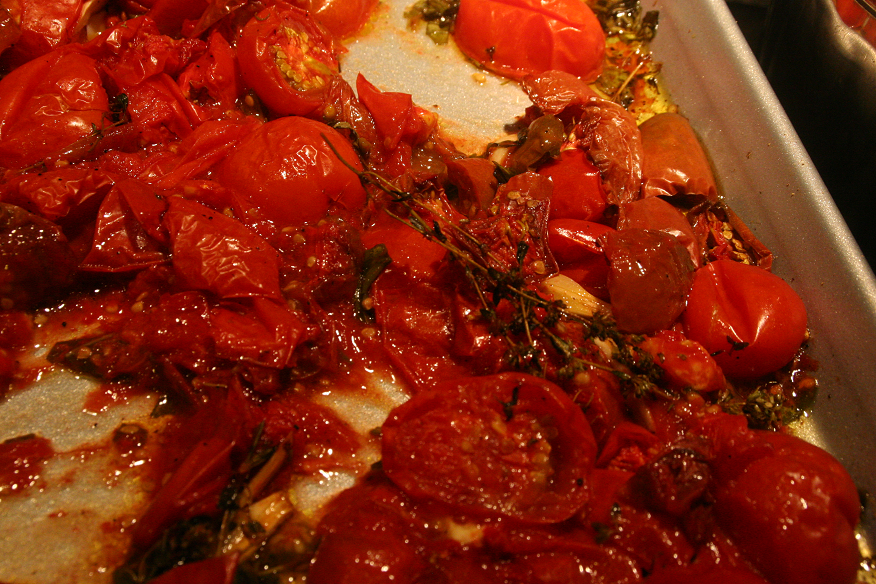
Tomato confit

Why is that when the temperature and humidity rises, I get the urge to cook and bake. I hate the heat; somehow standing over a hot stove or canning pots of boiling water makes it better.

So, last week’s heat brings me to tomato confit - tomatoes cooked in fat. Simple enough, but the results are amazing. I googled a bunch of tomato confit recipes. Some of them were kind of putsy, blanching the tomatoes first, deseeding the tomatoes. Me, I don’t care so much about it. I want to keep this as simple as possible. Why do tomatoes need to be deseeded? I have not gotten a good answer from everyone I’ve asked. It is a texture thing? Or a visual thing? Do the seeds react with the heat and become toxic?

I got some ripe tomatoes, a good handful of thyme, rosemary and basil from the garden. Turned the oven to 200°. In a sided jelly roll pan, I poured a some olive oil, sprinkled some kosher salt and pepper. Washed and chopped the herbs, sprinkled them into the oil. sliced a couple of garlic cloves, added them to the herb and oil mess in the jelly roll pan. Added a pinch of sugar. Cut the tomatoes into 1 inch chunks. The tomatoes went into the pan, cut side down. Put it all in the preheated oven turned on the oven fan. After an hour, I stirred the tomatoes. Every half hour after that, I opened the oven to let moisture escape. The tomatoes collapse and start to dehydrate. Juice from the tomatoes mingle with the herbs and olive oil. The color of the tomatoes deepen. About two and a half hours later, I pull them out of the oven. And when they are cooled, I jar them up and stick it in the fridge. The confit can last about 2 weeks in the fridge. I’m trying to freeze some, but am a little concerned that the tomatoes will totally disintegrate, which would be ok for sauces.

My house smells so good.

It's hot. It's humid. It's time to boil vinegar.

Sunday, August 1, 2010


Ok this site has been quiet long enough.

Some know me as Susu. Some know me as Mrs. Yam. One five-year-old I met camping last year knows me as Monster Gramma.

It’s now August and it’s hot and humid. Summer is not my season. I hate being hot. I hate sweating. So, what am I doing today? Pickling, which entails standing over pots of boiling vinegar, water and spices. This is an activity that forces one to be hot and sweaty. It’s 85 degrees and I’m guessing a dew point of 70. Minnesota is just not pleasant this time of year.

The Good Brother Yam is really good about indulging my whims. This morning’s whim was getting up early to go to the farmer‘s market, just to see what vegetables looked good for pickling and then have three or four pots of boiling water going on the stove for a while. We don‘t have air conditioning. The house is going to be hot enough without adding more heat and humidity. Oh well. That‘s life and hopefully, the pickles will make it worth it. Foregoing breakfast and, more importantly, coffee, we head to the Minneapolis Farmer’s Market - the one on North Lyndale at 8 am. That seems to be the sweet spot for Sunday mornings. After the hardcore marketers and before the church people show up.

Maybe it’s not too late for teeny tiny cucumbers. Baby carrots would be good. I’m thinking of the mixed vegetable pickles that are made by just sitting on the counter. However, I do have a quest. I have okra pickles on the brain. I’ve never had a pickled okra before, but I have to make them. I’m not sure why. I was *really* hoping for little tiny okras. That market is pretty big, so I figured I’d find something to pickle. We did find beautiful little okras and long thin purple carrots from some of the Hmong farmers. We also picked up with some heirloom tomatoes (Green Moldovan and Vorlon), sweet corn, and a melon from the Gysland Brothers - Todd and Reid are crazy heirloom tomato growers. I’m guessing 70 or more different varieties. They also do red peppers. Those peppers are another post…

We forgot to get eggs, so we stopped at the Kingsfield Market to pick up some eggs and the Chef Shack was there. Brother Yam had a brisket taco and I had a black bean and sweet potato taco for breakfast. That alone was worth the stop.

We dropped off our goods at home and then wandered through the U of M Arboretum. Brother Yam took pictures of their vegetable gardens (we are already planning next year’s garden). By this time, we are both dripping with sweat and we are getting crabby because of the heat. So, we spent some time checking out the library and bookstore, for the air-conditioning as much as for the books. I need to find the book Self-Sufficient Gardener (or something like it, I’ve already forgotten the name) by John Seymour. Brother Yam found a book to help identify weeds. It’s too bad that isn’t a lending library. When we got home, I checked my canning books for recipes. Since I‘m pretty new to canning, I rely pretty heavily on recipes. My main go-tos are Bell Complete Book of Home Preserving edited by Judi Kingry and Lauren Devine and The Complete Book of Small Batch Preserving by Ellie Toff and Margaret Howard. That book is worth getting just for the strawberry jam recipe. I also refer to Stocking Up edited by the editors of Organic Gardening and Farming. I also check out Food In Jars website and more recently Punk Domestics website for ideas and inspiration.

While I was perusing my books for recipes, Brother Yam made us some cocktails. We had some left over cherries from making a cherry liqueur with sour cherries we picked in Door County last year. They were pretty boozy. He put them in a blender with some ice and lime juice and came up with a pretty refreshing beverage. It gave me the strength to face pots of boiling liquid on this horribly hot and humid day.


I found a straight-forward okra pickle recipe in the Home Preserving book.:

3 cups of water
3 cups of white vinegar
1/3 cup pickling salt
2 teaspoons of dill seed
3.5 lbs of small whole okra
4 cloves of garlic
2 hot red peppers - halved and seeded.

Prepare cans and lids. This makes about 4 pints.

In a large stainless steel sauce pan, combine water, vinegar, pickling salt and dill seeds. Bring to a boil until salt is dissolved. Reduce heat to keep hot until ready to use.

Pack okra into hot jars. Add a clove of garlic and ½ seeded pepper. (I did not seed my peppers and I used a whole pepper. I like spicy pickles) ladle hot pickling liquid into jar to cover okra, leaving 1.2 inch headspace. Remove air bubbles. Add more liquid, if necessary. Wipe rims and place lids on the jars. Screw bands until resistance is met and it is finger-tip tight.

Place filled jars into canner. Make sure they are covered with water. Cover pot and bring to a boil and process for 15 minutes. Remove lid and wait 5 minutes, remove jars, cool, listen for the ping (I added this step) and store.

I can hardly wait to try these. I’m thinking Bloody Marys.


I found a fun carrot pickle in the Stocking Up book:

2-3 bunches of carrots
2 cups of vinegar
1.5 cups of water
0.5 Tablespoons of whole cloves
0.5 Tablespoons of allspice
0.5 Tablespoons of mace
0.5 stick of cinnamon
0.5 cups of honey

Pare carrots and cut in strips that are the desired size and length of your canning jars, if possible. (the carrots I used were so small, I did not need to cut them). Boil in water until just heated through ( I didn‘t do this, as my carrots are so young). Pack hot carrots lengthwise in hot sterilized pint jars. Make a syrup of vinegar, water and spices. Bring to a boil and simmer for 5 minutes. Add honey. Bring to a boil again. Pour over the carrots. There should be a ¼ inch headspace. Process pint jars in boiling water bath for 10 minutes.

I used purple carrots and the color of the raw carrots is spectacular. I hope they retain the color. I wish I had Brother Yam take some pictures of these before I canned them. They’ll probably turn grey as a result of the processing.

While my pickles were boiling away in the water bath, I took a cup of Greek yogurt, added a little milk, some sugar, a splash of orange blossom water and mixed well and threw it in the freezer.

I hate being hot and sweaty. I'm going to take a shower.

Followers